Curry House Chicken Jalfrezi
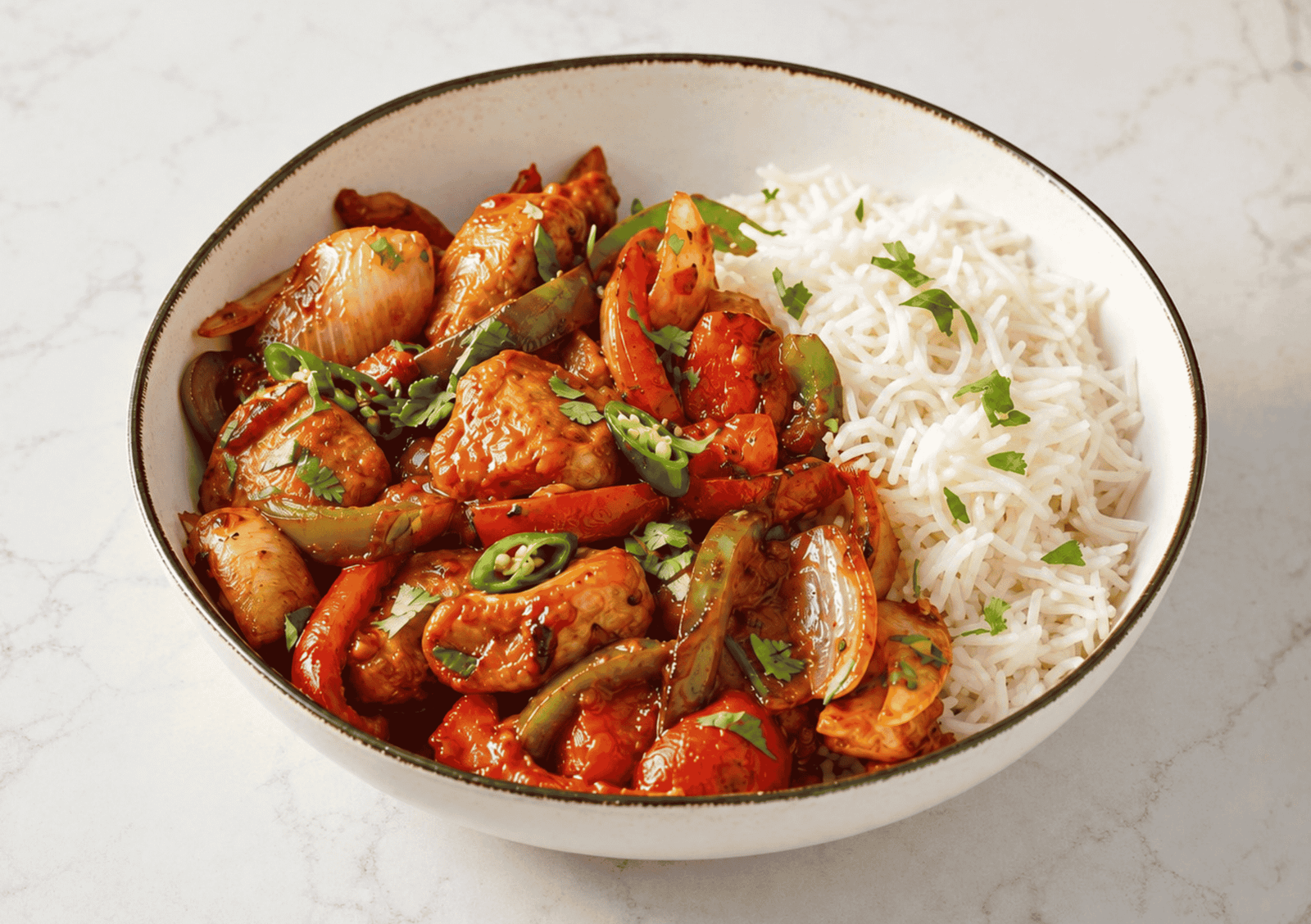
Curry House Chicken Jalfrezi combines tender pre-cooked chicken with strips of onion and pepper, fresh green chillies and a reduced tomato curry sauce. It is hotter and less gravy heavy than many British Indian Restaurant curries, with vegetables that retain some texture instead of disappearing into the sauce.
This version serves four and uses the prepared ingredients that make curry house cooking fast: base curry sauce, pre-cooked chicken, mixed powder and Garlic and Ginger Paste. Once everything is measured and the base sauce is hot, the final curry takes about 20 minutes.
What Is Chicken Jalfrezi?
Jalfrezi refers to a stir fried style of curry in which meat or vegetables are cooked quickly with onions, peppers, chillies and tomato. Modern curry house versions normally use pre-cooked meat and a prepared base gravy, allowing each portion to be assembled rapidly over a strong heat.
The vegetables are an important part of the finished dish. Onion and pepper should soften and colour around their edges while retaining enough bite to contrast with the chicken. The sauce should coat the ingredients rather than form a deep pool in the pan.
What Makes This a Curry House Jalfrezi?
A British Indian Restaurant kitchen prepares several components before service. The base curry sauce supplies the smooth onion body, while pre-cooked chicken can be heated in the finished sauce without waiting for raw meat to cook. Mixed powder provides a consistent spice foundation, and Garlic and Ginger Paste cooks quickly into the oil.
These preparations change both the speed and texture of the curry. A from-scratch Jalfrezi can be cooked successfully in one pan, but it will not have the same smooth gravy or rapid reduction as this curry house method.
How Spicy Is Chicken Jalfrezi?
Chicken Jalfrezi is generally served medium hot or hot. This recipe uses green finger chillies and Kashmiri chilli powder, producing clear chilli warmth without relying entirely on very hot dried chilli powder.
For a milder curry, remove the seeds from the green chillies and reduce the Kashmiri chilli powder. For more heat, leave the seeds in or add one small hot green chilli. Fresh chillies vary considerably, so adjust them separately from the ground spices.
Do not stir uncooked chilli powder into the finished curry. Ground spices need a short period in the hot pan followed by moisture so their raw flavour can cook out.
Why Should the Peppers and Onions Retain Some Bite?
The lightly charred vegetables distinguish Jalfrezi from smoother curries. If the onion and peppers are cooked until completely soft, the dish loses the fresh stir-fried character that gives it contrast.
Use a wide, heavy frying pan or sauté pan and heat it properly before adding the vegetables. A 30cm pan with a capacity of at least 3 litres gives this four person batch enough surface area and headroom. A small or overcrowded pan traps steam and softens the vegetables before they can colour.
Cut the onion and peppers into strips of similar thickness. Thin slivers collapse too quickly, while large pieces can remain raw inside after the sauce has reduced.
Which Prepared Ingredients Do You Need?
This recipe uses Curry House Base Sauce, Curry House Pre-Cooked Chicken, Mixed Powder, Garlic and Ginger Paste and Garam Masala. Prepare these in advance and heat the base sauce before beginning the final curry.
Drain the pre-cooked chicken before weighing it. Do not pour its full cooking liquid into the Jalfrezi because that can dilute the sauce and make the vegetables soft. The chicken cooking stock can be chilled separately and used in another curry.
Chicken tikka can replace the pre-cooked chicken if you want a more pronounced charred flavour. Both options are suitable, but they produce slightly different results.
How to Make Curry House Chicken Jalfrezi
Prepare and measure every ingredient before heating the pan. Keep the base curry sauce simmering gently in a separate saucepan and use a wide 30cm frying pan or sauté pan for the curry. Add the base sauce in measured stages so the final consistency remains under control. See the recipe card at the bottom for exact quantities and printable directions
Ingredients
- Rapeseed oil
- Brown onion
- Red pepper
- Green pepper
- Green finger chillies
- Garlic and Ginger Paste
- Mixed Powder
- Kashmiri chilli powder
- Double concentrated tomato purée mixed with water
- Hot Curry House Base Sauce
- Curry House Pre-Cooked Chicken
- Fresh tomatoes
- Dried fenugreek leaves
- Garam Masala
- Fine salt
- Lemon juice
- Fresh coriander
Cooking Instructions
Step 1: Sear the onion and peppers. Heat most of the rapeseed oil in a wide pan over a medium high heat. Add the onion, red pepper and green pepper, spreading them across the hot surface. Stir-fry for 3 to 4 minutes until the edges begin to colour but the vegetables remain firm.
Step 2: Cook the chillies and aromatic paste. Add the sliced green chillies and cook for 30 seconds. Push the vegetables towards the edge, add the remaining oil to the centre and stir in the Garlic and Ginger Paste. Cook for 30 to 45 seconds, stirring continuously so it loses its raw aroma without scorching.
Step 3: Add the ground spices. Sprinkle in the Mixed Powder and Kashmiri chilli powder. Stir for about 20 seconds so the spices coat the vegetables and become fragrant. Move immediately to the next step if they begin sticking.
Step 4: Cook the diluted tomato purée. Pour in the tomato purée and water mixture. Stir well and let it bubble for 1 to 2 minutes, until it darkens slightly and no longer smells raw.
Step 5: Begin building the sauce. Add the first measured portion of hot Curry House Base Sauce. Bring it to a lively simmer and cook for 2 minutes, scraping any caramelised sauce from the sides of the pan back into the curry.
Step 6: Heat the pre-cooked chicken. Add the drained pre-cooked chicken and the second measured portion of base sauce. Stir gently and simmer for 3 to 4 minutes so the chicken heats through without breaking apart.
Step 7: Add the tomatoes and finish reducing. Add the tomato wedges and only as much of the final portion of base sauce as the curry needs. Simmer uncovered for 3 to 4 minutes, until the chicken is steaming hot throughout and the sauce clings to the meat and vegetables. The tomatoes should soften at their edges while retaining their shape.
Step 8: Add the finishing seasonings. Crush the dried fenugreek leaves between your fingers and stir them into the curry with the Garam Masala and most of the coriander. Cook for 30 seconds, then season with salt and lemon juice. Remove from the heat and finish with the reserved coriander.
How Much Base Curry Sauce Should You Use?
Keep 500ml of hot base sauce ready, but add it in three portions. The first two 200ml additions build and heat the main sauce. The final 100ml is available for adjusting the consistency after the tomatoes and chicken are in the pan.
You may not need all of the final portion. Pan width, burner strength and moisture from the vegetables affect how quickly the curry reduces. Stop adding sauce when the ingredients are thoroughly coated and a spoon drawn through the pan leaves a path that closes slowly.
Cool and refrigerate any unused base sauce promptly. Do not pour it into the curry merely to avoid having a small quantity left over, as excessive simmering will soften the vegetables and can dry the chicken.
Can You Make Chicken Jalfrezi with Raw Chicken?
You can, but it should be cooked separately before the vegetables are stir-fried. Cut raw chicken thigh or breast into bite sized pieces, fry it until completely cooked, transfer it to a clean plate and then make the Jalfrezi in the same pan.
Adding raw chicken directly to the sauce lengthens the simmering stage. By the time the centre of every piece is safely cooked, the peppers and onions may have lost their intended texture.
For the closest curry house result, use the pre-cooked chicken recipe or chicken tikka and follow the method as written.
Why Is My Chicken Jalfrezi Watery?
The base sauce may have been added too quickly, the pan may be too narrow or the tomatoes may have released more moisture than expected. Keep the pan uncovered and allow each addition of base sauce to reduce before adding more.
If the chicken is already fully heated, lift it onto a warm plate while the sauce reduces. Return it for the final minute so it does not become dry. Do not add extra tomato purée at the end because it will not have enough time to lose its raw taste.
Why Are the Vegetables Too Soft?
A crowded pan or insufficient heat causes the onion and peppers to steam. Use a broad pan, preheat it properly and avoid covering the curry. The initial stir-fry should be brief because the vegetables continue cooking after the base sauce is added.
If your hob heats slowly, cook the vegetables in two batches and return the first batch before adding the chillies and Garlic and Ginger Paste.
Variations and Substitutions
Chicken tikka can replace the pre-cooked chicken in the same quantity. Add it at Step 6 and handle it gently so its charred coating remains on the pieces.
For Lamb Jalfrezi, use tender pre-cooked lamb and allow an extra minute for the denser pieces to heat through. Fried paneer can be used for a vegetarian version, although Paneer Jalfrezi is better treated as its own recipe because paneer needs gentler handling.
A medium curry powder can replace Mixed Powder when necessary. Begin with slightly less because commercial blends vary in strength and may contain more fenugreek or chilli.
Do not replace dried fenugreek leaves with an equal quantity of ground fenugreek. The ground seed is considerably stronger and more bitter. If the leaves are unavailable, omit them rather than making a direct substitution.
What to Serve with Chicken Jalfrezi
Serve Chicken Jalfrezi with plain basmati rice when you want the spicy, tomato-led sauce to remain the main flavour. Pilau Rice adds more aroma and works well when the curry is part of a larger meal.
Naan or Chapati can be used for gathering the reduced sauce. Cucumber Raita provides a cooling contrast, while Red Onion Chutney or Coriander and Mint Chutney brings acidity and freshness.
Can You Prepare Chicken Jalfrezi in Advance?
The base sauce and chicken are intended to be prepared ahead. The final curry is better cooked shortly before serving because refrigerated peppers and onions soften when reheated.
If you need to work ahead, slice the vegetables, measure the spices and portion the prepared ingredients into separate containers. Cook the complete curry when required so the vegetables retain their texture.
Storage and Reheating
Cool leftover Chicken Jalfrezi promptly and place it in a shallow covered container in the refrigerator within two hours. Eat it within 48 hours. Reheat it once only, stirring until the chicken and sauce are steaming hot throughout.
The curry can be frozen for up to three months for quality, but the onion and peppers will become softer after thawing. Freeze individual portions, defrost them in the refrigerator and reheat thoroughly on the hob or in a microwave.
Add only a small splash of water or base sauce if the gravy has thickened during storage. Too much liquid will change the relatively dry Jalfrezi consistency.

Curry House Chicken Jalfrezi
Ingredients
- 45 ml rapeseed oil divided into 30ml and 15ml
- 1 medium brown onion approximately 150g, cut into 1cm wedges
- 1 red pepper approximately 150g after trimming, cut into 1cm strips
- 1 green pepper approximately 150g after trimming, cut into 1cm strips
- 2 green finger chillies finely sliced, deseeded for less heat if preferred
- 30 g Garlic and Ginger Paste
- 2 tablespoons Mixed Powder
- 1 teaspoon Kashmiri chilli powder or ½ teaspoon for a milder curry
- 40 g double-concentrated tomato purée mixed with 80ml water
- 500 ml hot Curry House Base Sauce divided into 200ml, 200ml and up to 100ml
- 600 g drained Curry House Pre-Cooked Chicken
- 2 medium tomatoes approximately 200g, each cut into six wedges
- 1 teaspoon dried fenugreek leaves
- 1 teaspoon Garam Masala
- ½ teaspoon fine salt plus more if required
- 2 teaspoons lemon juice plus more if required
- 20 g fresh coriander leaves and tender stalks finely chopped, divided
Instructions
- Heat a 30cm frying pan or sauté pan with a capacity of at least 3 litres over a medium high heat. Add 30ml rapeseed oil, followed by the onion, red pepper and green pepper. Stir-fry for 3 to 4 minutes until the edges begin to colour while the vegetables remain firm.
- Add the green chillies and cook for 30 seconds. Push the vegetables towards the edge, add the remaining 15ml oil to the centre and stir in the Garlic and Ginger Paste. Cook for 30 to 45 seconds, stirring continuously.
- Add the Mixed Powder and Kashmiri chilli powder. Stir for about 20 seconds, keeping the spices moving so they become fragrant without burning.
- Pour in the diluted tomato purée. Stir well and cook for 1 to 2 minutes, until it darkens slightly and loses its raw aroma.
- Add the first 200ml hot Curry House Base Sauce. Bring it to a lively simmer and cook for 2 minutes, scraping any caramelised sauce from the sides back into the pan.
- Add the drained pre-cooked chicken and the second 200ml base sauce. Stir gently and simmer for 3 to 4 minutes.
- Add the tomato wedges and only as much of the final 100ml base sauce as required. Simmer uncovered for 3 to 4 minutes, until the chicken is steaming hot throughout, the tomatoes retain their shape and the sauce clings to the ingredients.
- Crush the dried fenugreek leaves between your fingers and stir them into the curry with the Garam Masala and 15g coriander. Cook for 30 seconds. Season with ½ teaspoon salt and 2 teaspoons lemon juice, then adjust if required. Remove from the heat and garnish with the remaining 5g coriander.
Notes
- Heat the base sauce before beginning so it does not cool the pan.
- Add the base sauce in stages. Keep any unused part of the final 100ml for another curry.
- Drain the pre-cooked chicken before weighing it. Adding all its cooking stock can make the Jalfrezi watery.
- Use a wide pan and cook uncovered so the onion and peppers retain some bite.
- Chicken tikka can replace pre-cooked chicken in the same quantity.
- Dried fenugreek leaves and ground fenugreek are not direct substitutes.
- Prepared ingredient cooking time is not included in the 35 minute total.