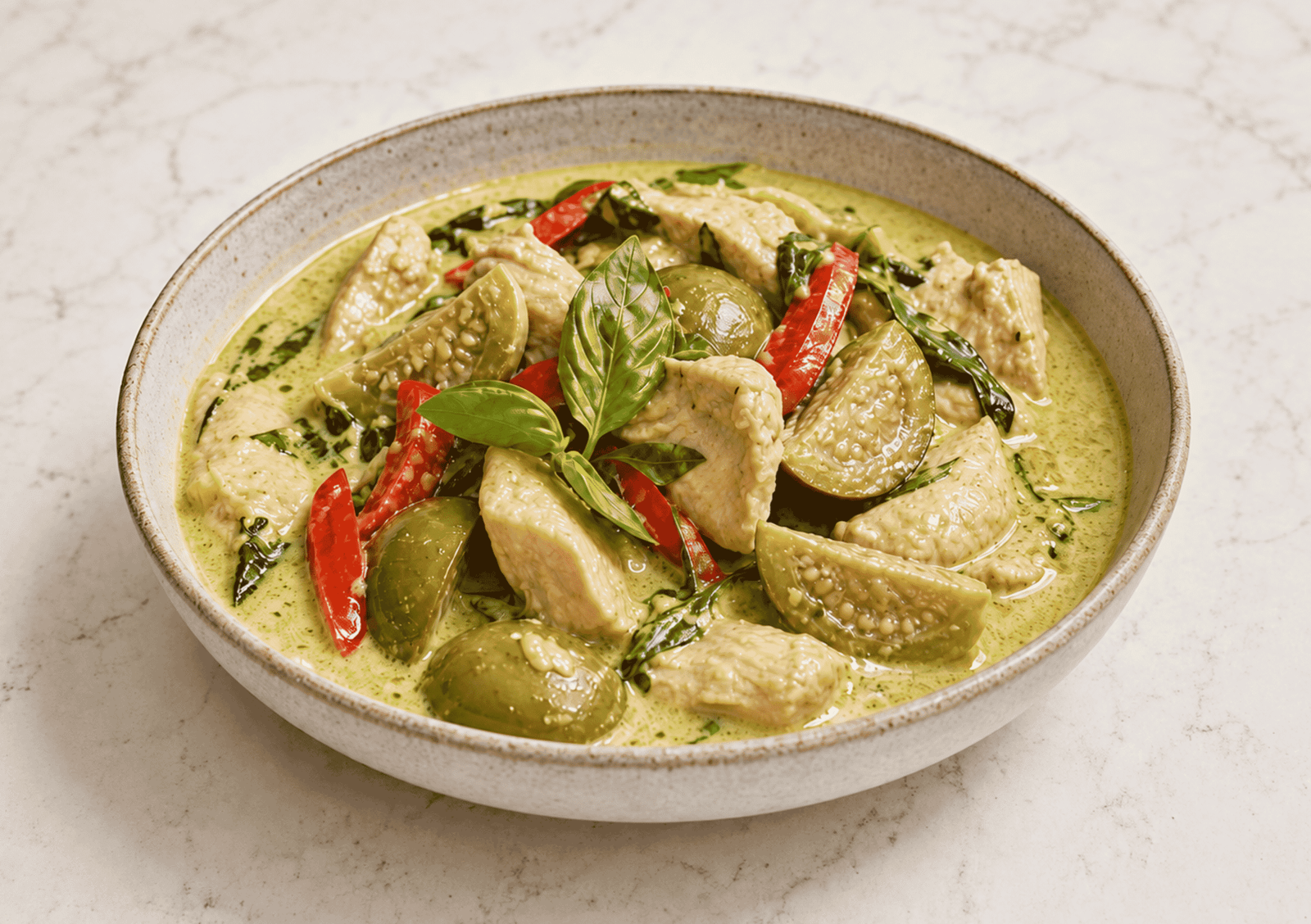
Thai Green Chicken Curry (Gaeng Khiao Wan)
Thai green chicken curry combines tender chicken thigh, coconut milk, green curry paste, makrut lime leaves, Thai aubergines and Thai basil in a fragrant, gently sweet and savoury sauce. It is a lively curry with fresh herbal notes and a level of heat that can be adjusted through the curry paste.
This version uses a traditional cooking principle that is practical at home. Part of the coconut milk is reduced before the curry paste is added, helping the paste release its aroma without requiring a separate cooking oil. Chicken thighs then simmer in the sauce until tender before the aubergines and fresh basil are added.
What Is Thai Green Curry?
Thai green curry, called gaeng khiao wan in Thai, is a coconut milk curry flavoured with a paste based on fresh green chillies and aromatic ingredients. Depending on the paste, those aromatics may include lemongrass, galangal, shallots, garlic, coriander root, makrut lime zest and shrimp paste.
The word green refers to the colour produced by the fresh chillies and herbs in the paste. It does not mean that the curry is mild. Thai green curry can be hotter than red curry, although the final heat depends heavily on the chillies and the brand or recipe used for the paste.
Chicken is a common choice, but green curry can also be prepared with pork, beef, fish, seafood or vegetables. This recipe uses boneless chicken thighs because they remain tender during simmering and contribute more flavour to the sauce than chicken breast.
What Should Thai Green Curry Taste Like?
A well-balanced green curry should taste savoury, aromatic and moderately rich, with enough sweetness to round out the chilli rather than dominate it. Fish sauce supplies salt and savoury depth, palm sugar softens the sharper edges, and coconut milk carries the flavour of the curry paste.
Makrut lime leaves and Thai basil contribute two different aromatic notes. The lime leaves perfume the curry while it simmers, whereas the basil is stirred in after cooking so its fragrance remains fresh.
The sauce should be loose enough to spoon over rice. It is not intended to have the dense consistency of many South Asian curries.
Which Green Curry Paste Should I Use?
Both homemade and shop bought green curry paste work, but their strength can differ considerably. Some commercial pastes contain a high proportion of chilli and salt, while others are milder and need a larger quantity to produce a properly seasoned curry.
For an unfamiliar brand, begin with the quantity in the recipe and taste the sauce after the chicken has simmered. If the curry needs more paste, cook the additional paste in a small pan with a spoonful of coconut milk for 2 minutes before stirring it into the curry. Adding raw paste directly near the end can leave an uncooked, harsh flavour.
Check the ingredients if dietary requirements matter. Many green curry pastes contain shrimp paste, although some commercial versions are vegetarian.
What Are Thai Aubergines?
Thai aubergines are small, round aubergines with pale green or green striped skin. They have a firmer texture and a slightly bitter edge that works well against coconut milk. Cut them shortly before cooking because the exposed flesh browns quickly.
Keep the cut pieces under cold water if they will be standing for more than a few minutes. Drain them thoroughly before adding them to the curry.
If Thai aubergines are unavailable, use a small purple aubergine cut into 3cm pieces. It will soften more quickly and produce a different texture, so begin checking it after 3 minutes. Drained tinned bamboo shoots are another suitable alternative and only need a few minutes to heat through.
How to Make Thai Green Chicken Curry
Prepare the chicken, aubergines, lime leaves, pepper and basil before placing the pan over the heat. Once the curry paste has been cooked, the remaining stages move quickly. Keep the heat gentle after adding the chicken so the coconut sauce simmers without reducing too far.
See the recipe card at the bottom for exact quantities and printable directions
Ingredients
- Full fat coconut milk
- Thai green curry paste
- Fermented shrimp paste, optional
- Boneless, skinless chicken thighs
- Unsalted chicken stock
- Palm sugar or light brown sugar
- Fish sauce
- Makrut lime leaves
- Thai aubergines
- Red pepper
- Thai basil leaves
- Mild red chilli, optional
- Jasmine rice, to serve
Cooking Instructions
Step 1: Prepare the ingredients. Cut the chicken into even bite sized pieces. Quarter the Thai aubergines, cutting larger ones into additional wedges, and keep them submerged in cold water until required. Remove the central stems from the makrut lime leaves and tear each leaf into two or three pieces. Slice the red pepper and pick the Thai basil leaves from their stems.
Step 2: Cook the coconut milk and curry paste. Pour the first portion of coconut milk into a wide saucepan or wok and bring it to a steady boil over a medium high heat. Cook for 4 to 6 minutes, stirring regularly, until it has reduced and looks glossy. Add the green curry paste and optional shrimp paste. Cook for 2 to 3 minutes, stirring continuously, until strongly aromatic. If the mixture catches, loosen it with a splash of the measured chicken stock.
Step 3: Coat the chicken. Add the chicken thigh pieces and stir for 2 minutes so every piece is thoroughly coated in the cooked curry paste. The outside of the chicken should lose its raw colour, but it does not need to brown.
Step 4: Build the curry sauce. Pour in the remaining coconut milk and chicken stock. Add the palm sugar, the first measured portion of fish sauce and the torn makrut lime leaves. Bring to a gentle simmer, then cook uncovered for 10 to 12 minutes, stirring occasionally, until the chicken is nearly tender.
Step 5: Cook the aubergines. Drain the Thai aubergines and add them to the curry. Press them beneath the surface of the sauce and simmer for 4 to 5 minutes. They should be tender enough to pierce with a knife while retaining a little firmness.
Step 6: Finish and season the curry. Turn off the heat and stir in the red pepper and Thai basil. Allow them to soften in the residual heat for 1 minute. Taste the sauce and add some or all of the reserved fish sauce if it needs more seasoning. Garnish with sliced mild red chilli, if using, and serve with jasmine rice.
Why Cook the Curry Paste in Coconut Milk?
Cooking the paste before adding the main quantity of liquid removes its raw edge and helps release the fat soluble aromas from the chillies, lemongrass, galangal and spices. Reducing part of the coconut milk first concentrates its fat, allowing it to perform the same job as frying oil.
Some canned coconut milk is stabilised and may not visibly separate into oil. This is not a failure. Continue once the milk has reduced, the paste smells fragrant and the mixture has become thicker and glossy.
How Hot Is Thai Green Curry?
Green curry is often medium to hot, but the colour alone does not predict the heat. A paste made with plenty of small green bird’s eye chillies will be much hotter than a commercial paste designed for a broad audience.
For a milder curry, use a moderately spiced paste and increase the coconut milk slightly rather than cutting the paste so far that the sauce loses flavour. For extra heat, add finely sliced green bird’s eye chilli when frying the paste.
Do not add the full amount of fish sauce before tasting if the curry paste is already salty. The recipe deliberately reserves part of it for the final adjustment.
Tips for a Better Thai Green Curry
- Use full fat coconut milk because it gives the sauce sufficient body and carries the curry paste effectively.
- Cut the chicken into similar sized pieces so it cooks evenly.
- Do not boil the chicken aggressively. A gentle simmer keeps the thigh meat tender.
- Add Thai basil after turning off the heat so its aroma remains distinct.
- Do not overcook Thai aubergines. They should soften without collapsing into the sauce.
- Leave the makrut lime leaves in large pieces for infusion, but let diners know that the pieces are not intended to be eaten.
- Taste before adding the reserved fish sauce because the salt content of curry paste varies by brand.
Can I Use Chicken Breast?
Chicken breast can be used, but it needs a shorter cooking time. Slice it across the grain into pieces about 1cm thick and toss it with a teaspoon of fish sauce while preparing the other ingredients.
Make the sauce without the chicken and simmer it for 6 minutes. Add the aubergines, cook for 2 minutes, then add the sliced chicken breast and continue simmering for 3 to 4 minutes, or until the chicken is cooked through. Finish with the pepper and basil as directed.
Variations and Substitutions
Replace the Thai aubergines with drained bamboo shoots for a firmer, more convenient option. Add them during the final 3 minutes because they are already cooked.
For a vegetarian version, use firm tofu and unsalted vegetable stock. Choose a curry paste without shrimp paste and replace the fish sauce with a suitable vegetarian alternative. Check the seasoning carefully because different substitutes vary in saltiness.
Palm sugar has a rounded caramel note, but light brown sugar is a practical substitute. Ordinary granulated sugar can also be used, although it has a cleaner, less complex sweetness.
Thai basil has an aniseed aroma that differs from common sweet basil. If Thai basil is unavailable, sweet basil can provide freshness, but the finished flavour will change.
What to Serve with Thai Green Chicken Curry
Steamed jasmine rice is the clearest accompaniment because its soft texture and fragrance suit the loose coconut sauce. Spoon the curry beside or over the rice so each serving receives chicken, aubergine and plenty of sauce.
Thai green curry can also be served with thin rice noodles. A crisp cucumber salad is useful when the curry is particularly hot because it provides a fresh contrast without adding more richness.
How to Store and Reheat Thai Green Curry
Cool leftovers promptly and transfer them to a covered container. Refrigerate within two hours and use within two days. The aubergines will continue to soften, so reheat only until the chicken and sauce are piping hot throughout.
Reheat the curry gently in a saucepan over a medium low heat, stirring occasionally. Add a splash of water or chicken stock if the sauce has thickened during storage. Fresh Thai basil can be added after reheating to restore some of the herbal aroma.
The chicken and sauce can be frozen for up to three months for best quality, although the aubergines and basil lose some texture. For a planned freezer batch, freeze the curry after the chicken is cooked but before adding the vegetables and basil. Add freshly cooked vegetables and basil when reheating.

Thai Green Chicken Curry
Ingredients
- 400 ml full fat coconut milk divided into 150ml and 250ml portions
- 50 g Thai green curry paste
- 1 teaspoon fermented shrimp paste optional
- 500 g boneless skinless chicken thighs, cut into 3cm pieces
- 250 ml unsalted chicken stock
- 15 g palm sugar or light brown sugar
- 15 ml fish sauce plus up to 10ml extra for final seasoning
- 5 makrut lime leaves
- 250 g Thai aubergines
- 80 g red pepper cut into thin strips
- 25 g Thai basil leaves
- 1 mild red chilli thinly sliced, optional
- Steamed jasmine rice to serve
Instructions
- Cut the chicken into even 3cm pieces. Quarter the Thai aubergines, cutting larger ones into additional wedges, and keep them submerged in cold water. Remove the central stems from the makrut lime leaves and tear the leaves into pieces. Slice the red pepper and pick the Thai basil leaves.
- Pour 150ml coconut milk into a wide saucepan or wok and bring it to a steady boil over a medium high heat. Cook for 4 to 6 minutes, stirring regularly, until reduced and glossy. Add the green curry paste and optional shrimp paste. Cook for 2 to 3 minutes, stirring continuously, until aromatic. Loosen with a splash of the measured chicken stock if it begins to catch.
- Add the chicken thigh pieces and stir for 2 minutes, coating every piece in the cooked curry paste. The exterior should lose its raw colour without needing to brown.
- Add the remaining 250ml coconut milk, the remaining chicken stock, palm sugar, 15ml fish sauce and torn makrut lime leaves. Bring to a gentle simmer and cook uncovered for 10 to 12 minutes, stirring occasionally, until the chicken is nearly tender.
- Drain the Thai aubergines and add them to the curry. Press them beneath the sauce and simmer for 4 to 5 minutes, until tender enough to pierce with a knife but still slightly firm.
- Turn off the heat and stir in the red pepper and Thai basil. Leave for 1 minute so they soften in the residual heat. Taste and add up to 10ml additional fish sauce if needed. Garnish with the sliced mild red chilli, if using, and serve with jasmine rice.
Notes
- Green curry pastes vary in heat and saltiness. Taste before adding the reserved fish sauce.
- If more curry paste is required, cook it separately with a spoonful of coconut milk for 2 minutes before stirring it into the finished sauce.
- Small purple aubergine can replace Thai aubergine, but it may soften more quickly.
- Drained tinned bamboo shoots can replace the aubergine and only need about 3 minutes in the sauce.
- Large pieces of makrut lime leaf are used to infuse the curry and are not intended to be eaten.
- Refrigerate leftovers promptly and use within two days.