

British Curry House Base Sauce Recipe
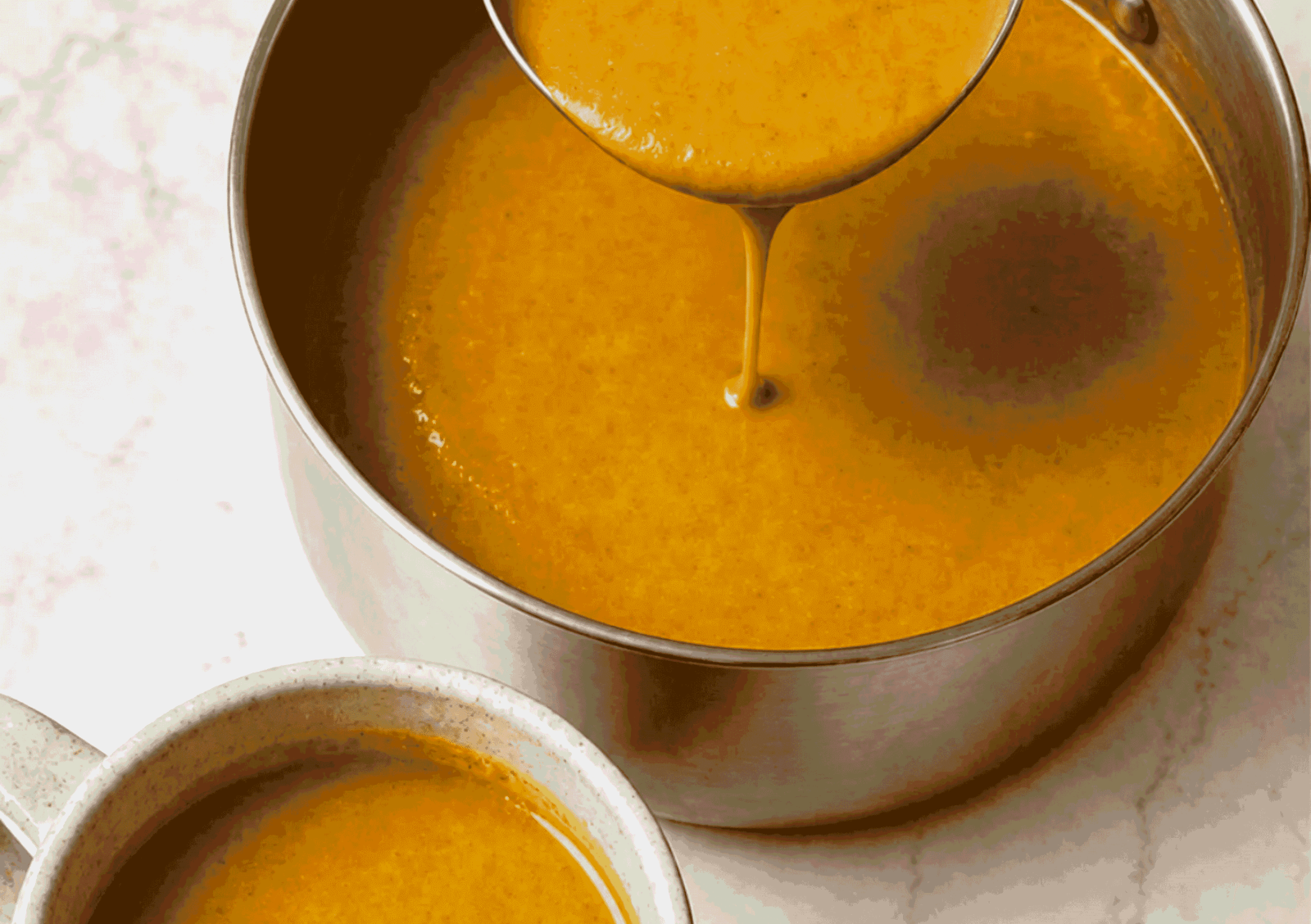
British curry house base sauce is the prepared onion gravy used to build many restaurant style curries. It is mild, smooth and deliberately thinner than a finished curry sauce, allowing it to reduce quickly around spices, meat and other ingredients in a hot pan.
This recipe makes approximately 3 litres of diluted sauce, enough for about five four person curries using 500ml to 700ml each. It can also be divided into smaller portions for individual curry house servings. Make it in advance, then use it for dishes such as Madras, korma, bhuna, vindaloo and Rogan Josh.
What Is Curry House Base Sauce?
Curry house base sauce, also called base gravy, is an onion led cooking sauce associated with British Indian Restaurant cooking. Onions and mild vegetables are simmered until completely soft, blended into a smooth gravy and diluted before use.
It is not a finished curry and should taste restrained on its own. The defining flavours of each dish are added later. Chilli, cream, coconut, tamarind, yoghurt and stronger spice blends belong in the individual curry unless a specific base sauce recipe has been designed around them.
Preparing the onions in advance allows a curry to be cooked in minutes. Instead of waiting for fresh onion to soften and form a sauce each time, the cook adds ladles of hot base sauce to spices and prepared meat, reducing each addition until the curry reaches the required texture.
Ingredients and Their Purpose
Onions provide most of the body. They need gentle, thorough cooking so their structure breaks down before blending. Deep browning is unnecessary because the base should remain adaptable enough for pale kormas as well as darker curries.
Carrot contributes mild sweetness, while green pepper adds a quiet savoury note. A small amount of cabbage gives body without leaving a recognisable cabbage flavour. The vegetables support the onion rather than competing with it.
Tinned tomato supplies acidity and colour. This recipe uses a moderate quantity because a strongly tomato based gravy would influence every curry made from it. Additional tomato can be introduced later through curry house tomato purée or fresh tomatoes.
Garlic and ginger paste establishes an aromatic background. Coriander, cumin, paprika and turmeric provide gentle seasoning and colour, but the quantities remain restrained. Mixed powder and other dish specific spices are added when the final curry is cooked.
Why Does the Base Sauce Need to Be Mild?
One batch should work across curries with very different flavour profiles. If the base contains large amounts of chilli, coconut, fenugreek or cream, those flavours will appear in every dish and make the finished curries taste too similar.
A mild base leaves room for the final pan to define the dish. Madras receives extra chilli and acidity, korma is finished with mild ingredients and richness, while bhuna is reduced until thick. The same gravy supports each result because it contributes cooked onion and texture rather than a complete seasoning profile.
Mild does not mean raw or flavourless. The vegetables should taste fully cooked, gently sweet and savoury, with no harsh onion, garlic or spice flavour.
Why Is Curry House Base Sauce So Thin?
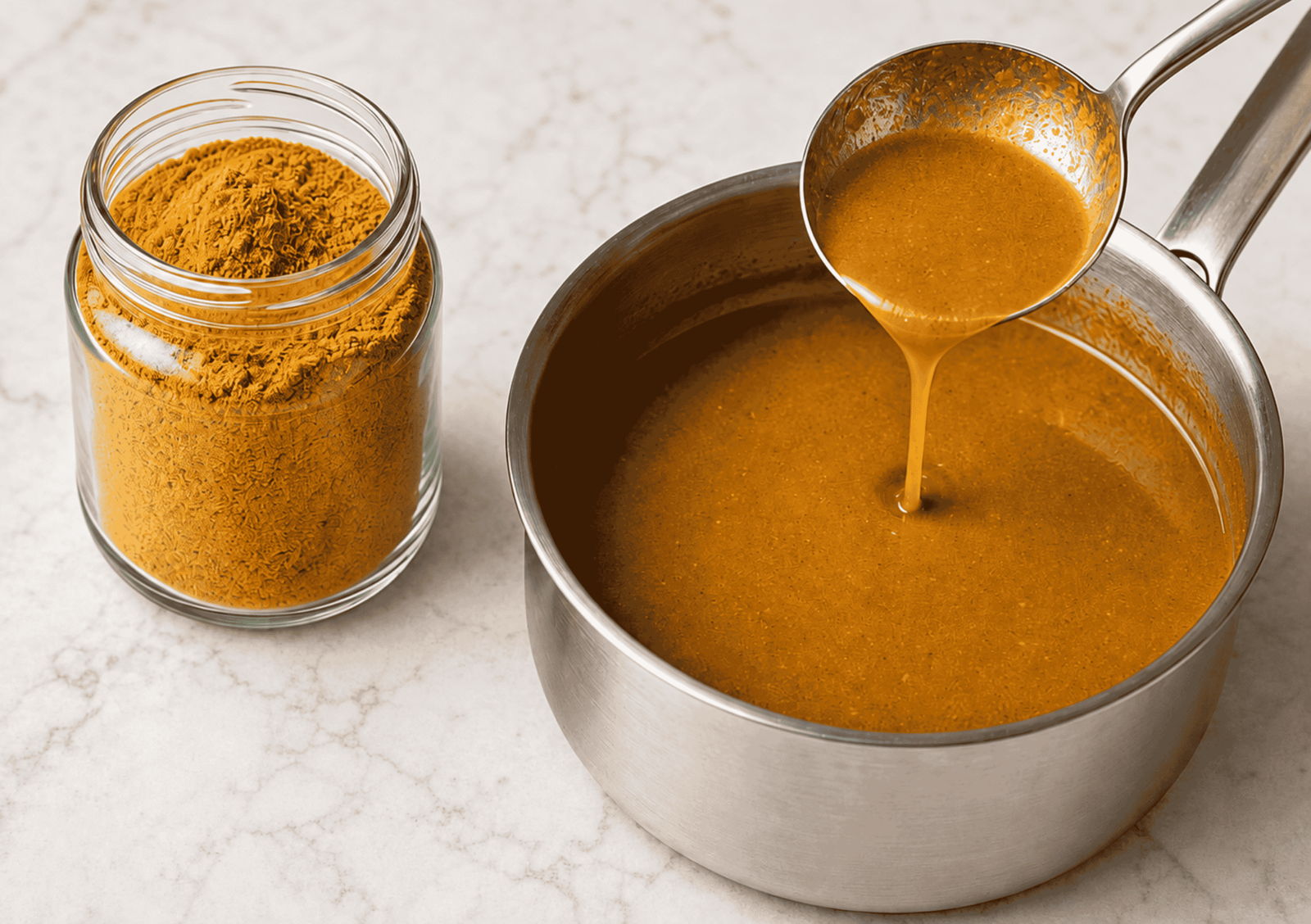
The diluted sauce should pour from a ladle in a steady stream. A consistency similar to full fat milk or thin single cream is a useful visual guide. This may look too loose at first, but the vegetable solids cause it to reduce quickly in a hot curry pan.
Thin sauce spreads across the pan and combines evenly with spices. It can be added in stages, with each ladle reducing before the next goes in. Thick gravy is more likely to sit in the pan, catch at the base and produce a heavy curry before the ingredients have cooked together.
Always judge the consistency while the sauce is hot because it thickens as it cools. If it does not pour freely after reheating, stir in more hot water.
How Smooth Should Base Curry Sauce Be?
The finished gravy should contain no obvious pieces of onion, vegetable fibres or gritty particles. Fully softened vegetables are essential because blending alone cannot reliably correct undercooked carrot or onion.
A stick blender is convenient for a large saucepan. Move it through the full depth of the mixture and continue until the surface looks even and glossy. A jug blender can give a finer result, but hot liquids must be handled according to the manufacturer’s instructions and the jug must not be overfilled.
If the sauce remains grainy, simmer it for another 10 minutes and blend again. Adding extra water may make it thinner, but it will not remove a coarse texture caused by undercooked vegetables.
How Much Base Sauce Is Needed for One Curry?
A four person curry will commonly use between 500ml and 700ml of diluted base sauce. A relatively dry bhuna may need less, while a saucier Madras or korma may use more. Follow the quantity stated in each Curry House Recipes article.
For a smaller curry serving one or two people, allow roughly 250ml to 300ml diluted sauce. These are working amounts rather than rigid rules because pan width, cooking heat and the desired final consistency affect how much liquid evaporates.
Whenever a recipe lists base curry sauce, the quantity means diluted, recipe ready sauce unless the article clearly says otherwise.
How to Make British Curry House Base Sauce
Use a stockpot with a capacity of at least 5 litres so the vegetables can simmer and the sauce can be blended safely. Cook everything until very soft, blend thoroughly, then dilute to the final volume. If you plan to freeze the sauce, portion some of it before the final dilution to save freezer space. See the recipe card at the bottom for printable directions
Ingredients
- 150ml rapeseed oil
- 1kg onions, peeled and roughly chopped
- 150g carrots, peeled and roughly chopped
- 100g green pepper, deseeded and roughly chopped
- 100g green cabbage, roughly chopped
- 200g tinned chopped tomatoes
- 60g garlic and ginger paste
- 2 teaspoons fine salt
- 2 teaspoons ground coriander
- 2 teaspoons ground cumin
- 1 teaspoon sweet paprika
- 1 teaspoon ground turmeric
- 1.5 litres freshly boiled water, plus approximately 750ml to 1 litre for dilution
Cooking Instructions
- Heat the rapeseed oil in a stockpot over a medium heat. Add the onions and salt, stir thoroughly and cook for 8 to 10 minutes. The onions should begin to soften but should not become deeply browned.
- Add the carrots, green pepper and cabbage. Cook for 5 minutes, stirring several times, so the vegetables soften slightly and become coated in the oil.
- Add the garlic and ginger paste. Stir continuously for 1 minute, until its raw aroma begins to soften without allowing it to catch on the bottom of the pot.
- Reduce the heat to medium to low. Add the ground coriander, cumin, paprika and turmeric. Stir for 30 seconds, then immediately add the chopped tomatoes and mix well.
- Pour in 1.5 litres of freshly boiled water. Bring the mixture to a gentle simmer, then partially cover the pot and cook over a low heat for 60 minutes. Stir every 15 minutes and add a splash of water if the vegetables are no longer mostly submerged.
- Remove the lid and check the vegetables. The carrot and onion should crush easily against the side of the pot with a wooden spoon. Simmer for another 10 to 15 minutes if any pieces remain firm.
- Remove the pot from the heat. Blend with a stick blender for 3 to 5 minutes, moving it carefully through the full depth of the sauce, until completely smooth. If using a jug blender, work in safe batches and follow the manufacturer’s guidance for hot liquids.
- Return the sauce to a low heat. Gradually add 750ml hot water, stirring well, then add more as required until the total volume is approximately 3 litres and the gravy pours like thin single cream. Bring it back to a gentle simmer for 5 minutes.
- Use the sauce immediately, or cool it promptly and divide it into labelled portions. Stir before measuring because the vegetable solids may settle as it stands.
Should I Freeze the Sauce Before Diluting It?
Freezing the thick blended concentrate saves space. Complete step 7, then measure the concentrated sauce and decide how many portions you need. Label every container with the amount of hot water required after defrosting rather than relying on memory.
For example, if your concentrate measures 2 litres and needs 1 litre of water to reach the final 3 litre consistency, each 400ml concentrated portion will need approximately 200ml water. The exact ratio can vary because onions contain different amounts of moisture, so consistency matters more than following a fixed ratio.
Defrost a portion thoroughly in the fridge, transfer it to a saucepan and add the labelled amount of water. Heat it until steaming hot, then adjust with a little more hot water if it remains too thick.
What Size Portions Should I Freeze?
For recipes serving four, freeze enough concentrate to produce 500ml to 700ml diluted sauce. A practical choice is to divide this batch into five equal portions, with each portion making roughly 600ml after dilution.
For individual curry house portions, divide it into ten equal portions, each making around 300ml diluted sauce. Small flat containers or freezer bags laid on a tray until solid save space and defrost more quickly than one large block.
Write the recipe name, freezing date, concentrated quantity and required dilution amount on each portion. Clear labels prevent concentrated gravy being mistaken for recipe ready sauce.
Which Curries Use Base Curry Sauce?
Base sauce is central to many British curry house recipes. It can support Chicken Madras, Chicken Korma, Chicken Tikka Masala, Chicken Jalfrezi, Lamb Rogan Josh, Lamb Bhuna, Chicken Dhansak, Lamb Vindaloo, Chicken Pathia, Chicken Chasni, dopiaza and curry house saag dishes.
Each finished curry still needs its own aromatics, spices, prepared meat and finishing ingredients. The base sauce replaces the slow onion preparation, not the entire recipe.
Variations and Substitutions
Red pepper can replace green pepper, although it makes the sauce slightly sweeter. White cabbage or savoy cabbage can replace standard green cabbage. Avoid red cabbage because it changes the colour of the gravy.
If cabbage is unavailable, leave it out and add another 50g carrot and 50g onion. The sauce will still work, although its flavour and body will be slightly different.
Sunflower oil can replace rapeseed oil. Olive oil has a more noticeable flavour and is less neutral in this style of sauce. Ghee can be used, but it makes the base richer and less adaptable for dishes where a neutral background is preferred.
This recipe is naturally mild. Do not add chilli powder simply to make the base taste more complete. Heat is easier to control in each finished curry.
Cooking Tips
- Use a large pot with spare capacity. A pot filled close to the rim is difficult to stir and unsafe to blend.
- Keep the onions pale. Deep caramelisation creates a darker, more dominant base that is less suitable for mild curries.
- Add the water immediately after the ground spices and tomatoes. Dry spices can burn quickly and make the whole batch bitter.
- Cook the vegetables until they collapse under light pressure. This has a greater effect on smoothness than blender power alone.
- Blend for longer than seems necessary. Check a spoonful under good light for fibres or small pieces before diluting.
- Dilute while hot. Cold sauce appears thicker and can lead you to add the wrong amount of water.
- Keep the sauce hot when cooking a curry. Cold base sauce lowers the pan temperature and slows the rapid reduction needed for curry house texture.
Why Is My Base Sauce Grainy?
The vegetables may have been undercooked, the batch may need more liquid during blending or the blender may not have run long enough. Return the sauce to a gentle simmer until every piece is very soft, then blend again for several minutes.
A food processor often leaves a coarser texture than a strong jug blender or stick blender. If using a jug blender, process small batches and observe the manufacturer’s hot liquid safety instructions.
Why Does My Base Sauce Taste Bitter?
Garlic, ginger or ground spices may have scorched before the water was added. Once spices are burnt, dilution rarely removes the bitterness. Use moderate heat, keep the mixture moving and add the tomatoes and water promptly.
An excessive amount of turmeric can also taste harsh. Measure the spices rather than estimating them, and remember that the base is meant to be lightly seasoned.
How to Store and Reheat Base Curry Sauce
Divide the sauce into shallow containers so it cools promptly. Place it in the fridge or freezer within two hours of cooking. Refrigerated sauce should be used within 48 hours or frozen.
Freeze the sauce in labelled recipe sized portions and use within three months for best quality. Defrost thoroughly in the fridge. Reheat only the amount required until steaming hot throughout, stirring well to eliminate cold spots.
Base sauce should be hot when added to a curry. Reheat it in a separate saucepan and keep it at a gentle simmer while cooking the final dish.

British Curry House Base Sauce
Ingredients
- 150 ml rapeseed oil
- 1 kg onions peeled and roughly chopped
- 150 g carrots peeled and roughly chopped
- 100 g green pepper deseeded and roughly chopped
- 100 g green cabbage roughly chopped
- 200 g tinned chopped tomatoes
- 60 g garlic and ginger paste
- 2 teaspoons fine salt
- 2 teaspoons ground coriander
- 2 teaspoons ground cumin
- 1 teaspoon sweet paprika
- 1 teaspoon ground turmeric
- 1.5 litres freshly boiled water
- 750 ml to 1 litre hot water for dilution
Instructions
- Heat the oil over a medium heat. Add the onions and salt and cook for 8 to 10 minutes without deeply browning.
- Add the carrots, pepper and cabbage. Cook for 5 minutes, stirring regularly.
- Add the garlic and ginger paste and cook for 1 minute.
- Reduce the heat. Stir in the coriander, cumin, paprika and turmeric for 30 seconds, then add the tomatoes.
- Pour in 1.5 litres boiled water. Partially cover and simmer gently for 60 minutes, stirring every 15 minutes.
- Check that the vegetables crush easily. Simmer for another 10 to 15 minutes if necessary.
- Remove from the heat and blend for 3 to 5 minutes until completely smooth.
- Return to a low heat. Add 750ml to 1 litre hot water until the sauce measures approximately 3 litres and pours like thin single cream. Simmer for 5 minutes.
- Use immediately or cool promptly and divide into labelled portions.



3 Comments