Curry House Pre-Cooked Spinach Recipe
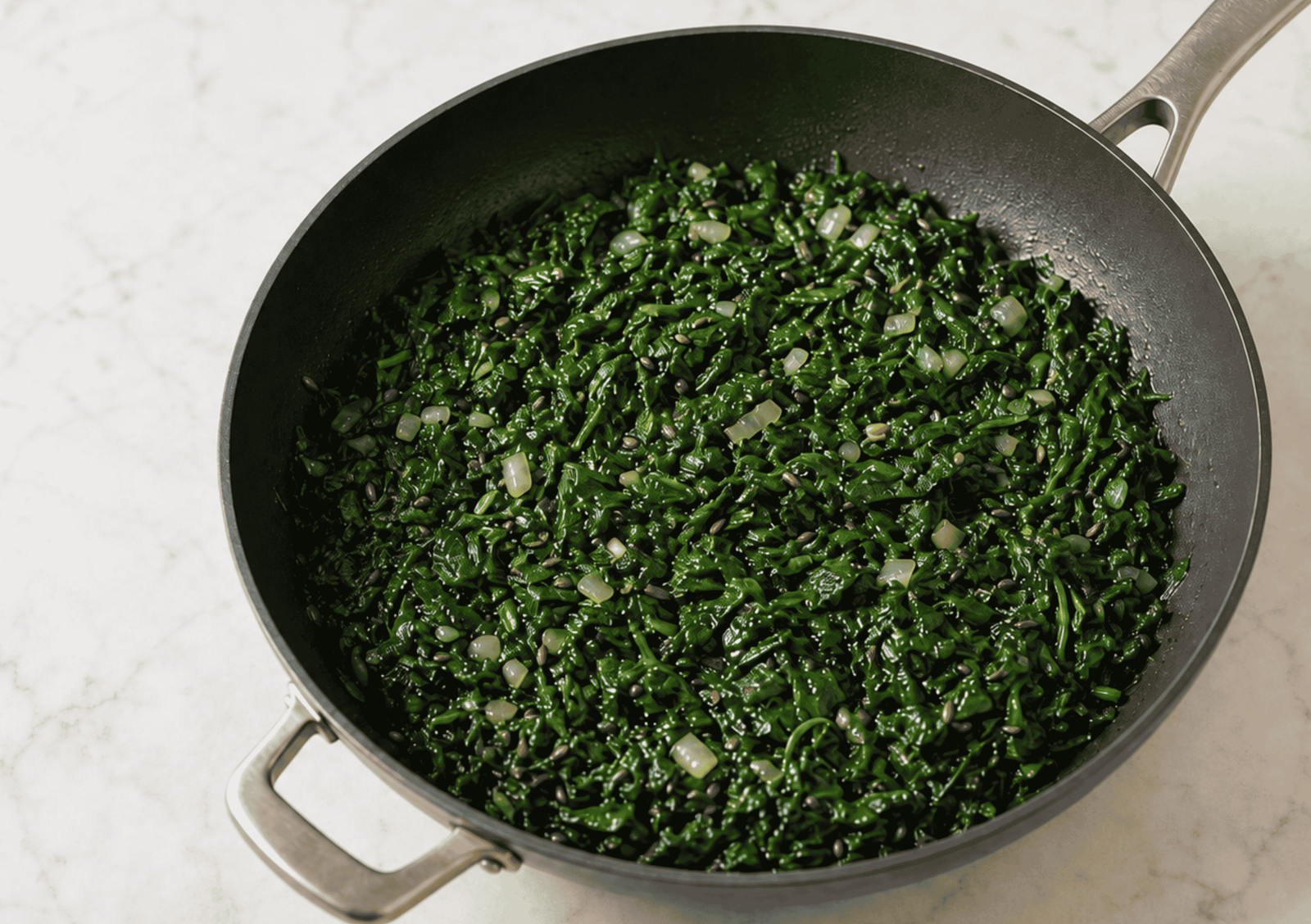
Curry house pre-cooked spinach is a mild prepared ingredient for saag curries, vegetable dishes and curry house sauces. The spinach is briefly blanched, cooled, squeezed and finely chopped before being cooked with softened onion, Garlic and Ginger Paste and a restrained whole spice tempering.
Preparing it separately gives you control over its moisture and texture. When raw spinach is added straight to a nearly finished curry, it can release enough water to weaken the sauce. A measured portion of this preparation can instead be stirred into a hot pan and reduced quickly.
The batch is deliberately free from chilli and heavily flavoured ground spices. That keeps it adaptable enough for mild Saag Paneer, hotter Chicken Saag, Saag Aloo and other dishes that need a cooked spinach component.
What Is Curry House Pre-Cooked Spinach?
This is a prepared curry component rather than a complete side dish. It combines drained spinach with onion, aromatics and gentle whole spices so it is ready to become part of another recipe.
Advance preparation is central to British curry house cooking. Base sauce, pre-cooked proteins, spice blends and vegetables can be combined in different ways when an order is placed. Keeping spinach ready serves the same purpose and prevents every saag dish from beginning with a pan full of raw leaves.
The finished spinach should be finely chopped and moist, but it should not leave water behind when spooned into a pan. It can be kept textured for dishes such as Saag Aloo or blended briefly when a smoother curry sauce is wanted.
Why Blanch the Spinach First?
Blanching collapses a large quantity of leaves in a very short time. This makes the spinach easier to cool, squeeze and chop evenly.
The brief cooking time also helps preserve a greener colour than prolonged boiling. Moving the wilted leaves directly into very cold water stops residual heat from continuing to soften them.
Most importantly, blanching and squeezing remove water before the spinach reaches the final curry. You can then reduce the finished sauce without having to cook the greens for an excessive length of time.
Which Spinach Should You Use?
Fresh baby spinach is the easiest option because its stems are tender. Check the packaging, discard any damaged leaves and wash it unless it is clearly labelled as ready to eat.
Mature spinach also works and can have a stronger leafy flavour. Remove thick or fibrous stalks before weighing it, then wash the leaves thoroughly in several changes of cold water.
Frozen leaf or chopped spinach is a practical alternative. It has already been blanched, so it only needs to be thawed and squeezed before it is added to the spiced onion mixture. Avoid frozen creamed spinach because the added dairy and seasoning make it unsuitable as a neutral prepared ingredient.
What Is Panch Phoron?
Panch phoron is a whole spice mixture usually containing fenugreek, nigella, cumin, black mustard and fennel seeds. The seeds are kept whole and fried briefly in oil before the onion is added.
Fenugreek and mustard become bitter when scorched. Use medium heat and add the onion as soon as the seeds begin to sizzle and release their aroma.
The seeds remain in the finished spinach. If you do not have panch phoron, use cumin seeds and nigella seeds for a simpler tempering. This changes the flavour, but it still produces a useful curry preparation.
How to Make Curry House Pre-Cooked Spinach
Use a saucepan with a capacity of at least 4 litres so the leaves can be submerged safely. Prepare the cold water before blanching because the spinach cooks very quickly. Once the leaves are cool, squeeze out the loose water, chop them finely and cook them through the spiced onion mixture. See the recipe card at the bottom for exact quantities and printable directions
Ingredients
- Fresh baby spinach
- Rapeseed oil or another neutral cooking oil
- Cassia bark
- Indian bay leaf
- Panch phoron
- Onion
- Garlic and Ginger Paste
- Ground turmeric
- Fine salt
- Very cold water and ice, for cooling
- Water, only if needed while frying
Cooking Instructions
Step 1: Prepare the blanching station. Bring a large saucepan of water to a rolling boil. Fill a large bowl with very cold water and add ice if available. Place a colander beside the bowl so everything is ready before the leaves enter the pan.
Step 2: Blanch the spinach. Add half the spinach to the boiling water and press the leaves below the surface. Blanch just until completely wilted, then lift it into the cold water. Repeat with the second batch so the pan is not overcrowded.
Step 3: Cool and squeeze the leaves. Turn the spinach through the cold water until no warmth remains, then drain it. Squeeze it firmly in small handfuls until it feels damp but no longer drips. Removing this water now prevents the finished curry from becoming thin.
Step 4: Chop the spinach. Place the compacted spinach on a board and chop it finely in several directions. Retain a little leafy texture rather than reducing it to a completely smooth purée.
Step 5: Temper the whole spices. Heat the oil in a wide frying pan over medium heat. Add the cassia and Indian bay leaf, followed by the panch phoron. Stir only until the seeds begin to sizzle and smell aromatic, taking care not to darken the fenugreek.
Step 6: Soften the onion and aromatics. Add the onion with the measured portion of salt. Cook until soft and lightly golden, stirring regularly. Add the Garlic and Ginger Paste and stir continuously until its raw aroma softens without allowing it to catch.
Step 7: Cook the spinach. Reduce the heat to medium low, add the turmeric and immediately stir in the chopped spinach. Cook until the leaves are hot and evenly distributed through the onion. Add a small splash of water only if the mixture is sticking to the pan.
Step 8: Season and portion. Remove and discard the cassia and Indian bay leaf. Add the remaining salt, taste and adjust only if needed. Use the spinach immediately, or spread it in a shallow container so it cools promptly before being divided into portions.
How Much Water Should You Squeeze Out?
Squeeze the spinach until it no longer releases droplets when pressed. A handful should feel damp and flexible, not saturated or completely dry.
Work in small handfuls because this gives more control than trying to compress the entire batch at once. Clean hands work well, although a potato ricer can be used gently in small amounts.
Do not continue squeezing until the spinach becomes crumbly. If too much moisture is removed, it may catch when it is added to the onions and require water to loosen it again.
Should the Spinach Be Chopped or Blended?
Fine chopping is the most versatile choice. It leaves enough texture for Saag Aloo and vegetable dishes while still distributing easily through a curry sauce.
For a smoother saag curry, pulse the cooled preparation briefly with a stick blender or food processor. Stop while a little texture remains. Adding water makes the batch harder to store and can thin the curry in which it is used.
Do not process hot spinach in a sealed jug blender. Let it cool and follow the appliance manufacturer’s instructions for hot ingredients.
Can You Use Frozen or Tinned Spinach?
Frozen spinach works well. Thaw 500g completely, squeeze out the excess liquid and chop it if the pieces are large. Skip the blanching and cooling stages, then begin with the whole spices and onion.
Tinned spinach can be used when necessary, but its colour and texture are softer. Drain it thoroughly, check whether it contains added salt and add it only after the onion and aromatics have cooked. Fresh or frozen spinach gives a more reliable batch for use across several curries.
How Much Pre-Cooked Spinach Goes into a Curry?
For a curry serving four in which spinach is an addition, start with about 100g. This is enough to turn a curry house sauce into a saag variation without making spinach the dominant ingredient.
For Chicken Saag, Lamb Saag or Saag Paneer serving four, use approximately 350g to 450g, depending on the amount of sauce and how spinach led you want the dish to be. This recipe makes about 450g, which is suitable for one generous spinach curry or several smaller additions.
Loosen a chilled portion with a spoon before adding it. Stir it into the hot sauce and cook until the entire curry is steaming hot, adding more only after checking the consistency.
Which Recipes Use This Spinach Preparation?
Use it in Saag Paneer, Chicken Saag, Lamb Saag, Saag Aloo and Chana Saag. It can also be folded into vegetable bhaji, dhal, keema or a Balti sauce.
A 100g portion works well with Curry House Pre-Cooked Potatoes for a quick Saag Aloo. For Saag Paneer, reduce the curry sauce before adding the prepared spinach, then fold in Fried Paneer near the end so the cheese remains tender.
Keep the prepared batch mild. Chilli, garam masala, cream, lemon and other finishing ingredients can then be chosen for the final dish rather than limiting how the spinach can be used.
Why Is the Prepared Spinach Watery?
The leaves may not have been squeezed firmly enough, or the pan may be too narrow for steam to escape. Continue cooking uncovered over medium heat and stir regularly until no loose water collects at the base.
Do not thicken the prepared spinach with flour or ground nuts. Those additions restrict how it can be used later. Controlled reduction is the better solution.
Why Does the Spinach Taste Bitter?
Scorched panch phoron is the most likely cause. Add the onion promptly once the seeds begin to sizzle so the temperature of the pan drops.
Too much turmeric can also create a dry, bitter edge. The small amount in this recipe is enough to support the seasoning without masking the spinach.
Mature leaves may naturally taste stronger than baby spinach. Make seasoning adjustments in the finished curry, where salt, sauce and a small amount of acidity can balance that flavour.
Variations and Substitutions
- Simpler whole spice tempering: Replace the panch phoron with cumin seeds and nigella seeds.
- Garlic only: Use finely chopped garlic instead of Garlic and Ginger Paste for a more direct garlic flavour.
- Smoother preparation: Briefly blend the cooled spinach without adding water.
- Hot batch: Add finely chopped green chilli with the onion only if every portion is intended for a spicy dish.
- No onion: Omit the onion and reduce the oil. Watch the Garlic and Ginger Paste carefully because it can catch more quickly without the onion’s moisture.
- Vegan preparation: The recipe is naturally vegan when made with neutral oil.
Cooking Tips
Blanch the spinach in batches so the water stays close to boiling. Crowding the saucepan leaves some leaves cooking for much longer while the rest are being submerged.
Have the cold water ready before blanching. The spinach cooks in seconds, and leaving it hot in a colander allows residual heat to keep softening it.
Count the cassia and Indian bay leaf as they enter the pan and remove both before portioning. They become difficult to see once surrounded by the dark chopped spinach.
Keep the seasoning restrained. Salt and spice become more concentrated as a curry reduces, so strong adjustments are better made in the final dish.
Use a wide frying pan for the spiced onion and spinach. The larger surface area allows excess steam to escape and makes it easier to turn the leaves through the aromatics.
How to Store and Freeze Pre-Cooked Spinach
Spread the cooked spinach in a shallow container so it cools efficiently. Cover it and place it in the fridge or freezer within two hours of cooking.
Keep refrigerated portions for up to 48 hours. Divide the batch into 100g portions for adding to different curries, or store it as one 450g batch for a spinach led dish.
For freezing, use airtight containers or freezer bags and press out excess air. Use within three months for best quality. Flat bags stack neatly and thaw more evenly.
Defrost in the fridge, add the spinach to the finished dish and heat until steaming hot throughout. Reheat only the amount you intend to serve.

Curry House Pre-Cooked Spinach
Ingredients
- 500 g fresh baby spinach
- Very cold water and ice for cooling
- 30 ml rapeseed oil or another neutral cooking oil
- 1 x 5cm piece cassia bark
- 1 Indian bay leaf
- 2 teaspoons panch phoron
- 150 g onion finely chopped
- 20 g Garlic and Ginger Paste
- ¾ teaspoon fine salt divided
- ¼ teaspoon ground turmeric
- Up to 30ml water only if needed
Instructions
- Bring water to a rolling boil in a saucepan with a capacity of at least 4 litres. Fill a large bowl with very cold water and ice, then place a colander nearby.
- Add the spinach in two batches. Press each batch below the boiling water and cook for 30 seconds, just until wilted, then transfer it immediately to the cold water.
- Once the spinach is completely cool, drain it. Squeeze it firmly in small handfuls until damp but no longer dripping.
- Chop the squeezed leaves finely in several directions, retaining a little leafy texture.
- Heat the oil in a wide frying pan over medium heat. Fry the cassia and Indian bay leaf for 30 seconds, then add the panch phoron and stir for 15 to 20 seconds, just until the seeds begin to sizzle.
- Add the onion and ½ teaspoon salt. Cook for 6 to 8 minutes, stirring regularly, until soft and lightly golden. Add the Garlic and Ginger Paste and stir continuously for 45 seconds.
- Reduce the heat to medium low. Add the turmeric and chopped spinach, then cook for 3 to 4 minutes, turning it through the onions until evenly combined and hot. Add up to 30ml water only if the mixture begins to catch.
- Remove and discard the cassia and Indian bay leaf. Stir in the remaining ¼ teaspoon salt and adjust only if needed. Use immediately, or spread in a shallow container and cool before portioning.
Notes
- For frozen spinach, thaw and squeeze 500g frozen leaf or chopped spinach, skip Steps 1 to 4 and begin at Step 5.
- Use about 100g when spinach is an addition to a curry serving four.
- Use 350g to 450g for a spinach led curry serving four.
- Keep the master batch mild and adjust chilli, garam masala and acidity in the final dish.
- Refrigerate within two hours and use within 48 hours, or freeze promptly.